
About A Boy | John Wilson and Kenny Mammarella-D’Cruz explore the cultural forces shaping men today
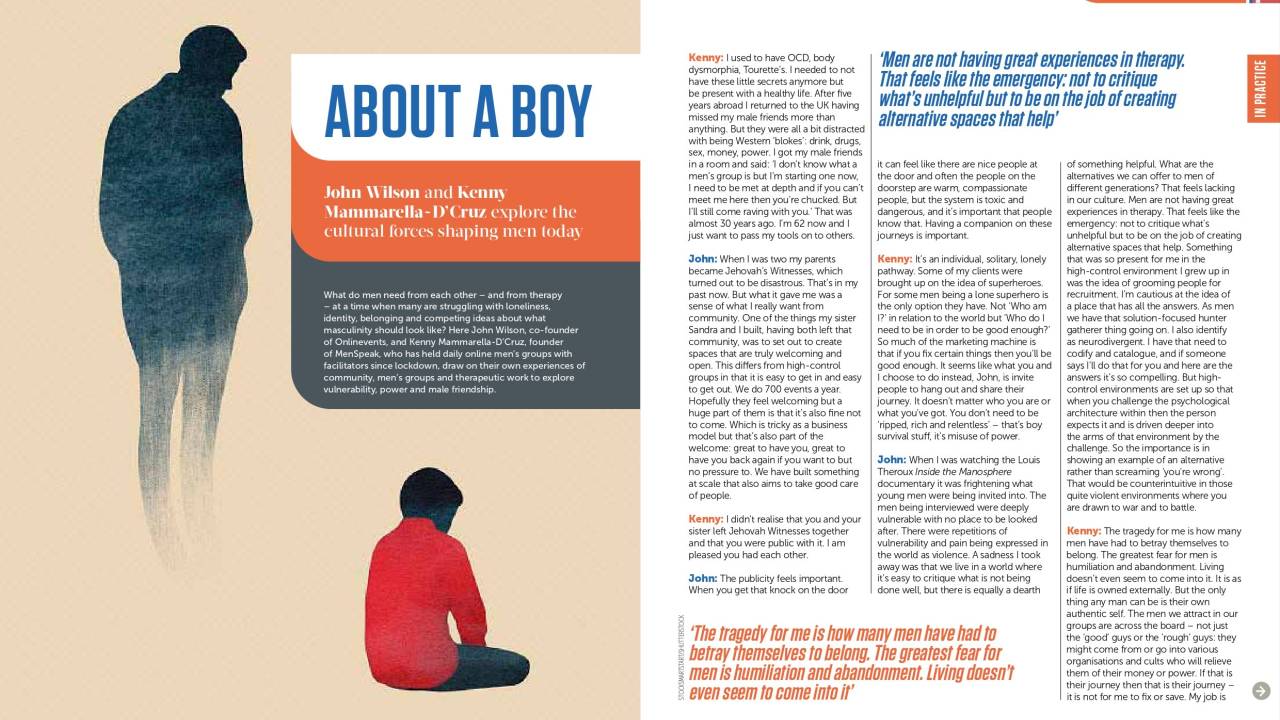
What do men need from each other – and from therapy – at a time when many are struggling with loneliness, identity, belonging and competing ideas about what masculinity should look like? Here John Wilson, co-founder of Onlinevents, and Kenny Mammarella-D’Cruz, founder of MenSpeak, who has held daily online men’s groups with facilitators since lockdown, draw on their own experiences of community, men’s groups and therapeutic work to explore vulnerability, power and male friendship.
Kenny: I used to have OCD, body dysmorphia, Tourette’s. I needed to not have these little secrets anymore but be present with a healthy life. After five years abroad I returned to the UK having missed my male friends more than anything. But they were all a bit distracted with being Western ‘blokes’: drink, drugs, sex, money, power. I got my male friends in a room and said: ‘I don’t know what a men’s group is but I’m starting one now, I need to be met at depth and if you can’t
meet me here then you’re chucked. But I’ll still come raving with you.’ That was almost 30 years ago. I’m 62 now and I just want to pass my tools on to others.
John: When I was two my parents became Jehovah’s Witnesses, which turned out to be disastrous. That’s in my past now. But what it gave me was a sense of what I really want from community. One of the things my sister Sandra and I built, having both left that community, was to set out to create spaces that are truly welcoming and open. This differs from high-control groups in that it is easy to get in and easy to get out. We do 700 events a year. Hopefully they feel welcoming but a huge part of them is that it’s also fine not to come. Which is tricky as a business model but that’s also part of the welcome: great to have you, great to have you back again if you want to but
no pressure to. We have built something at scale that also aims to take good care of people.
Kenny: I didn’t realise that you and your sister left Jehovah Witnesses together and that you were public with it. I am pleased you had each other.
John: The publicity feels important. When you get that knock on the door it can feel like there are nice people at the door and often the people on the doorstep are warm, compassionate people, but the system is toxic and dangerous, and it’s important that people know that. Having a companion on these journeys is important.
Kenny: It’s an individual, solitary, lonely pathway. Some of my clients were brought up on the idea of superheroes. For some men being a lone superhero is the only option they have. Not ‘Who am I?’ in relation to the world but ‘Who do I need to be in order to be good enough? ’So much of the marketing machine is that if you fix certain things then you’ll be good enough. It seems like what you and I choose to do instead, John, is invite people to hang out and share their journey. It doesn’t matter who you are or what you’ve got. You don’t need to be‘ ripped, rich and relentless’ – that’s boy survival stuff, it’s misuse of power.
John: When I was watching the Louis Theroux Inside the Manosphere documentary it was frightening what young men were being invited into. The men being interviewed were deeply vulnerable with no place to be looked after. There were repetitions of vulnerability and pain being expressed in the world as violence. A sadness I took away was that we live in a world where it’s easy to critique what is not being done well, but there is equally a dearth of something helpful. What are the alternatives we can offer to men of different generations? That feels lacking in our culture. Men are not having great experiences in therapy. That feels like the emergency: not to critique what’s unhelpful but to be on the job of creating alternative spaces that help. Something that was so present for me in the high-control environment I grew up in was the idea of grooming people for recruitment. I’m cautious at the idea of a place that has all the answers. As men we have that solution-focused hunter gatherer thing going on. I also identify as neurodivergent. I have that need to codify and catalogue, and if someone says I’ll do that for you and here are the answers it’s so compelling. But high control environments are set up so that when you challenge the psychological architecture within then the person expects it and is driven deeper into the arms of that environment by the challenge. So the importance is in showing an example of an alternative rather than screaming ‘you’re wrong’. That would be counterintuitive in those quite violent environments where you are drawn to war and to battle.
Kenny: The tragedy for me is how many men have had to betray themselves to
belong. The greatest fear for men is humiliation and abandonment. Living doesn’t even seem to come into it. It is as if life is owned externally. But the only thing any man can be is their own
authentic self. The men we attract in our groups are across the board – not just the ‘good’ guys or the ‘rough’ guys: they might come from or go into various organisations and cults who will relieve
them of their money or power. If that is their journey then that is their journey –it is not for me to fix or save. My job is live my life in a way that is true to me. It’s the opposite to how I used to be,
which was the king of the victim club where nobody leaves, everyone is nice,there is no passion or intimacy, there is no violence, apart from passive aggression, and I wasn’t going to leave unless everyone left with me. This wasn’t doing anyone a favour. My biggest gift to myself and the rest of the victim club was to move on myself, and for anyone who wants to move on too I can be
there for them rather than feeding where they’re stuck.
John: I think about it as a full-contact sport. I come out of the person-centred
humanistic tradition where there is massive emphasis on unconditional positive regard. Those values have been core to my practice and can come with a real holding. But that can also showup as having so much space to the point of abandonment. I have seen that with some of my male clients. The evolution for me is to be all in. Lots of contact,a space where there is lots of holding, interaction and high challenge. There could be pushing, shoving, elbows –even in ways that may feel bruising – but it’s about contact and being able to feel each other and inviting each other into that. Gentleness is needed but so is fluidity and not letting someone drown in their desperation. I certainly needed people to grab me by the scruff of the neck, shake me and be in full contact.That male energy for contact can be quite physical at times. We have a lot of skills in the therapy field, and space is important, but if that is all that we are doing it feels pejorative.
Kenny: Physicality is fundamental.I know enough men who would goto get drunk and fight in order to beintimate with other men because thatwas the only physicality they’d get. I’mastounded by how many men in their20s, 30s, older do martial arts becauseof the physicality aspect. I had a best
friend and we would always be play fighting and tripping each other up. He would say to me: ‘I love when we do this because it means everything is OK.’ It brought safety. Or it spoke louder than words could speak. There’s a certain trust, meeting at the edge. It’s a masculine holding. The same with clients. There is all this stuff about ‘men don’t speak’ – well really it’s about the way we listen. The way to enquire, the way to tune into language, to know the pace and tone and how to speak so that they will speak. They’re invited in their own time without performance. Men in my experience are desperate to speak and be heard. It’s just that people don’t set the conditions for it. It’s tragic, the loneliness and isolation that this brings.
John: The question for us is are we up for that deep psychological and physical contact? If we are not we shouldn’t bein those spaces. We need to be available for it. It’s somewhere between a very
delicate holding and kicking the f***ingdoor down! We can only do that morechallenging work if we really care aboutthe people we are with. We don’t transform unless the person we are withloves us deeply. To do that appropriately,in a way that sits within the ethics thatwe’re signed up to, it needs that level ofenergy and engagement.
Kenny: What I also find uncomfortableand scary is that in the moments whenmen need to be met there are so manypeople willing to steal their lessons.They’ll say, ‘Here are all the answers,
be like me.’ It’s like, wait a minute, what are you doing stealing this person’s lessons, power, journey and unfoldment? This is parasitic! There can’t be anything good about this.
John: It’s so important to hold those boundaries. It’s also about welcoming whatever response we get back to how we respond to them too. When that gets in a mess there is so much shame in that.
Kenny: The shame and blame keeps people in limbo for so long. A line in our groups is that we name it rather than blame it or shame it. As we embody that it becomes normal, liberating, for things to be spoken out.
John: We’ve not done hierarchy well in the counselling world. I’ve needed male role models in my life. Being available to other younger men coming into the field needing to feel someone there welcoming them with more experience is important. But to appreciate that and not exploit it. We have so few models of this across the global culture. One of the next pieces of evolution for humans is finding a way to be together that matches our evolutionary state,which is hierarchical but not exploitative.
Kenny: I’ve just had a memory of a client who turned his back to me, but that was an important test. There are times when I’ve been tested, pushed, abused and punished for the sins of other
men. It is so healthy for them to purge it, for me to not take it personally and let it pass so that they can then show up. Some men need to punch the leader in order to rank higher in the pecking order. Over lockdown I would sometimes be scared to go into the groups because members
were out to get me because they saw meas the founder, the leader, the head –they had that issue that needed to playout. For it to play out publicly with men inthe room and everyone to be aware of
their own reactions is worth its weight ingold. This is being in the vulnerability, inthe raw, in the lost for words, unsafe, towant to run away, for this to be spokenout and for us to be in it together.
John: This is an important conversation about power. I’m a fan of Peggy Natiello’s
idea that power is not a zero-sum game. Personal power is not finite. I can make
mistakes but I’m not going to give up my power. We are inviting other men to live into their real personal power as well as keeping the space safe, because if there is no power holding the container that’sa very dangerous space. I’m on board with the humanistic idea that humans are deeply prosocial. Men have been in difficult relationships for thousands of
years; we’ve lived in oppressive systemsfor a long time and been oppressive as
men, so there is a lot coming downthrough the generations and in thedigital space as well. As much as peopleare in these environments like themanosphere and the high-control groupI was in, as much as it can feel right inthe moment, something feels off, andsomething in the organism is unsettled.There is an incongruence in the organismthat it knows. When we hear or
experience someone else that matches that prosocial experience it calls up something else. That’s the hopeful bit. Lots of this behaviour is symptomatic of something, and when we get to the core of who we are all that begins to change.
Kenny: The term ‘showing up’ rather than ‘showing off’ is screaming in my head. Increasingly men are around other men telling the truth about their difficulties rather than showing off about conquests and other nonsense like that. Who are these blokes that you’re trying to be accepted in the boys’ club with?I’d say so much of this is the difference between boy behaviour, lost boys and men who are growing into self-awareness. This is little to do with age and all to do with stage in life and where people are lost. They can be big burly men in their 40s, 50s, 60s who are still at the gates of the boarding school figuring life out. It is why I feel we need to be in it together; all of it can be welcome and none of it has to be wrong. As soon as there is information, we all get to learn how to navigate an authentic life with a quiet mind. So many men cannot sit still for a minute without scrolling for information or distraction. One of the biggest tragedies and causes of addiction and poor behaviour is the lack of an ‘off’ button. What do I need to do to make it stop? People can get suicidal or addicted to drugs or money or power or sex just to make it stop. These conversations can be groundbreaking because they are beyond survival into conscious living.In our daily online men’s groups we can stand on the shoulders of giants and learn from each others’ experiences and talk about failures, not just successes. We move into bigger and better lives not by being a smart a**e but by sharing the journey.
John: It’s a fairly recent thing for some humans to have the privilege of not worrying about where the next meal is coming from. It therefore brings us faceto face with this question: how are we going to live if we aren’t just surviving every day? We are leaning into new questions about being human. That power to push forward is a big part of testosterone, building things, changing things, bringing good things into the world. Doing this is not about giving up one for the other but about not becoming so internal that there isn’t an external voice and vice versa.
Kenny: As you talk about those who don’t know where the next meal is coming from, what we have so much in common is community. The whole ‘man up’ thing for me becomes ‘man up and
talk about it’. These are spaces from whichwe can share and grow. People can getto know about them and then know thatif they come they will be met, safe andhave life open up. We are in it together.Some details of group member experienceshave been changed for confidentiality